 Imago Printer
Imago Printer
Imago Printer
How to achieve metallic effects without expensive dies is no longer a niche question for luxury printers. It is a practical production decision. Digital toner foiling, cold foil transfer, metallic inks, and reflective laminates now offer convincing alternatives to traditional hot-stamping dies. Each method creates a different surface character. Some look mirror-bright. Others feel softer and more industrial.
Print-finishing specialist Andy Fetherman explains the design principle clearly: “The best effect is the one that supports the design, not the one that overwhelms it.” That advice matters when a small brand has limited tooling funds. A digital foiling unit can add gold lettering to short runs without manufacturing a custom die. A metallic ink can create a controlled sheen across a larger area. A reflective laminate can cover broad panels, but it may reduce recyclability or complicate later finishing.
The process still demands discipline. Start with a physical proof, not only a screen preview. Check registration around thin type and sharp logos. Test the foil against the actual paper grain. Dark, smooth stocks usually produce stronger contrast, while porous papers can soften fine details. Keep artwork simple.
Less can look richer.
In practice, no substitute matches every hot-stamped result. That is the uncomfortable part. Budget methods may show slight edge spread, uneven shine, or weaker rub resistance. However, careful substrate selection, calibrated pressure, and realistic artwork can deliver a premium appearance without a costly die. The best solution is often a compromise, tested honestly before production begins.
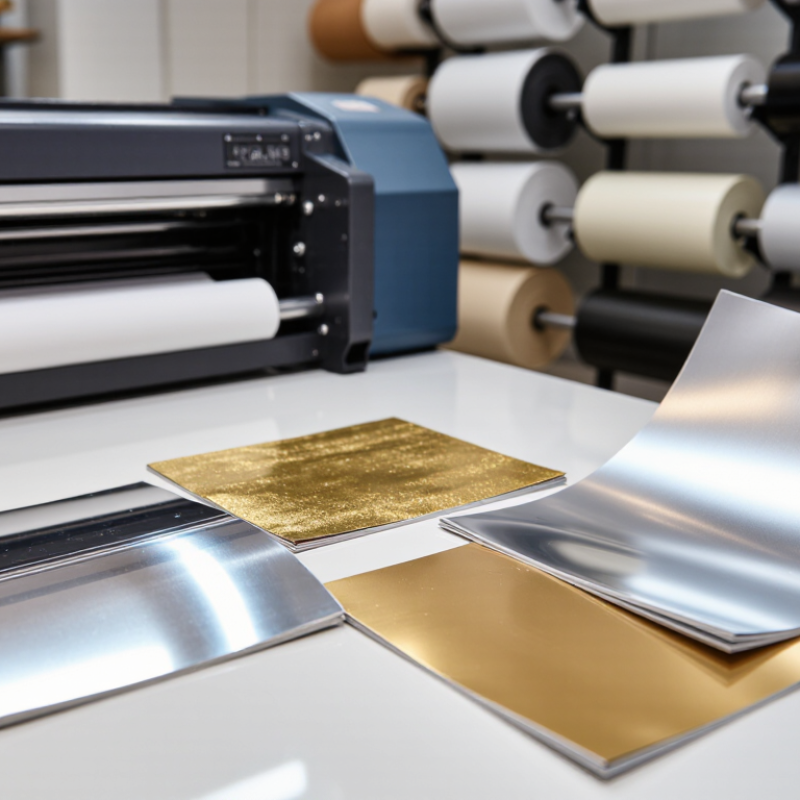
How to Achieve Metallic Effects Without Expensive Dies?
Metallic appearance can be engineered through pigment selection, surface texture, and measured light reflection. CIELAB gives the color a practical address. In CIE 15:2018, L* describes lightness from black to white, while a* and b* locate red-green and yellow-blue movement. Record the target under a defined illuminant and observer angle. A silver coating may look neutral on paper, yet shift toward blue under cool lighting. That mistake is common.
Gloss needs its own language. ISO 2813:2014 defines gloss measurement at 20°, 60°, and 85° geometries. The 60° setting suits many medium-gloss surfaces, while 20° exposes stronger reflections. Gloss units are referenced against polished black glass, with a nominal value of 100 GU. Measure the same panel direction each time. Metallic particles can create directional sparkle, so rotate the sample and record the variation. It is not perfect.
A useful workflow combines ΔE00 color difference, gloss units, and visual inspection under controlled lighting. CIEDE2000 can reveal small color shifts that ordinary viewing misses. For example, a target near L*=72, a*=1, b*=4 may need a lower b* value if the coating appears too warm. Keep coating weight, drying temperature, and substrate constant. ISO 2813 results can change when the surface is uneven, curved, or poorly cleaned. That limitation deserves attention, not concealment.
CIELAB gives color a measurable address. L describes lightness, while a and b show color movement. Record the illuminant and observer angle. A silver surface may look blue under cool lighting.
A target near L=72, a=1, and b=4 may work well. Lower b may reduce an overly warm appearance. Visual judgment still matters. Numbers alone are insufficient.
Use gloss measurements at 20°, 60°, or 85° geometries. The 60° setting suits many medium-gloss surfaces. The 20° setting reveals stronger reflections. Keep the panel direction consistent.
Metallic particles can create directional sparkle. Rotate the sample and record visible variation. A single viewing direction may hide uneven reflection. It is not perfect.
Combine CIEDE2000 color difference, gloss units, and controlled visual inspection. CIEDE2000 can reveal small shifts ordinary viewing misses. Compare samples under cool and warm lighting. Keep the judgment practical.
Coated stock between 200 and 350 gsm usually supports cleaner results. Around 250 gsm can balance detail and flexibility. Smooth coating helps metallic effects sit evenly. Heavier paper is not automatically better.
A smooth surface reduces dull patches and uneven metallic areas. It can also help fine silver lines appear cleaner. Lighter sheets may show pressure marks or curling. Substrate choice matters more than expected.
Include small text, gradients, and solid metallic blocks. Inspect the proof under cool and warm light. Check coating compatibility and drying conditions. Tiny details expose weaknesses quickly.
No. Production scale can introduce slight color or gloss changes. Drying, trimming, and handling may reveal scuffing later. I once approved a sample too quickly. That changed my checking process.
Use careful pigment selection, suitable coated stock, and controlled surface reflection. A short test run can reveal problems early. Leave space around delicate metallic details. Crowded artwork may look muddy.
How to achieve metallic effects without expensive dies? Begin by defining the desired metallic appearance with measurable standards, including CIELAB color values and gloss units assessed under ISO 2813. This creates a clear target for brightness, reflectivity, and color accuracy instead of relying only on visual judgment. Selecting 200–350 gsm coated stock can also improve surface smoothness, helping metallic details appear sharper and more consistent.
The effect can be produced with fine 5–25 μm metallic pigments or digital metallic toner at approximately 300–600 dpi, depending on the production method. For transfer applications, foil can be applied at 90–120°C without creating a custom metal die, reducing setup complexity and expense. Finally, quality should be verified by maintaining a ΔE00 of 3 or less and reviewing consistency according to ISO 12647-2 print metrics. Together, these steps provide a controlled, repeatable approach to achieving an attractive metallic finish while balancing efficiency, precision, and production cost.
